

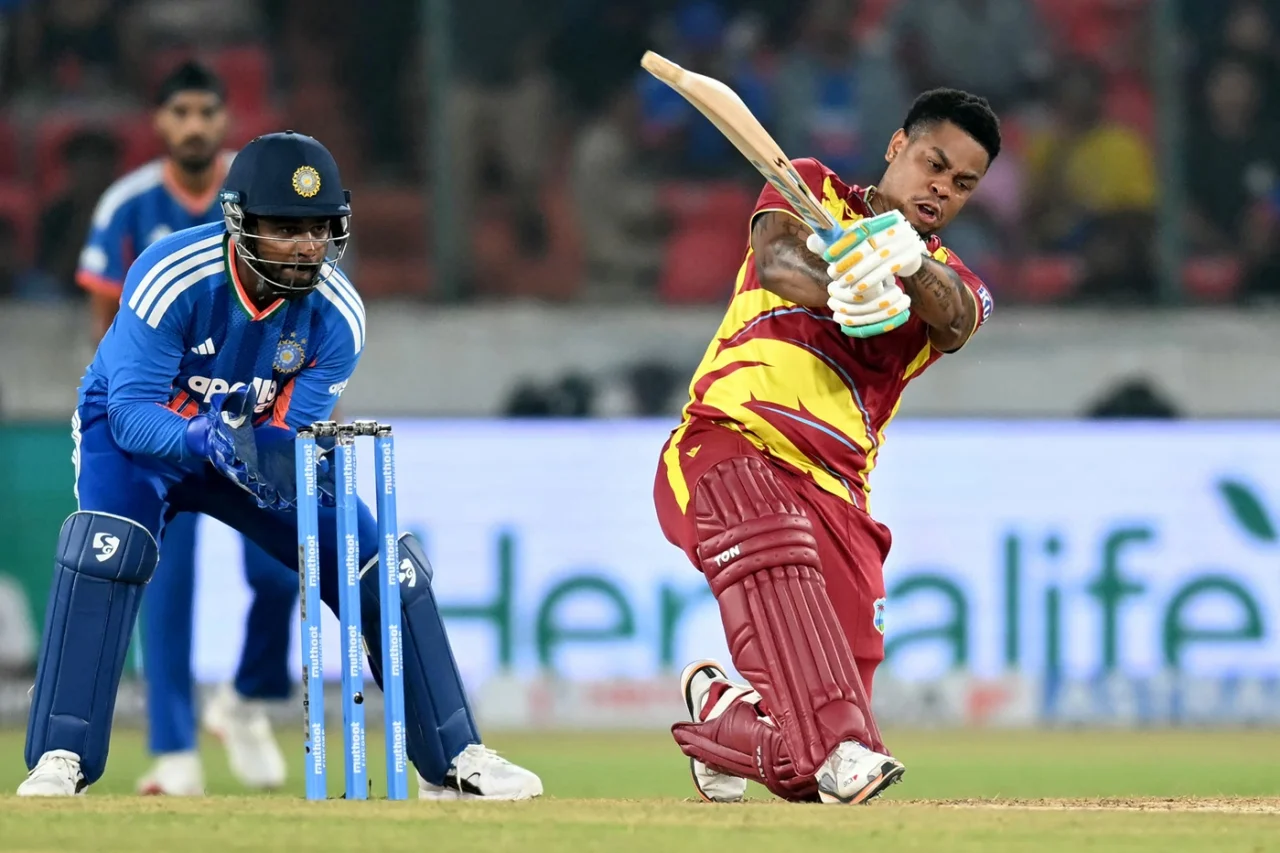
The Indian Cricket Team lost the fourth T20I against the West Indies by 24 runs. The high-scoring game saw the Indians falter against a massive total by the Windies.
The 4th India vs West Indies T20I of the five-match series was played at the Rajiv Gandhi International Stadium in Hyderabad. The home team won the toss and decided to field first on a flat batting track.
The West Indies got off to a flying start, scoring 79 runs in the first six. They then kept up the pace throughout the middle overs. Whenever they had a couple of slower overs, the two-time World Champions would compensate with a massive over.
On the back of captain Shai Hope’s second century in this series, the Windies managed to put up a mammoth total of 247/3 in 20 overs. However, with India’s scary batting order, the match was far from over.
India got off to a solid start of their own, scoring 60 runs in the first four overs. While Abhishek Sharma looked uncharacteristically cautious, Sanju Samson took charge of scoring, making a half-century in just 21 deliveries before getting out for 56 off 23.
The in-form Ishan Kishan would lose his wicket cheaply, and even captain Shreyas Iyer, who scored a ton in the first match of this series, scored just 16 runs.
Despite these early losses, India managed to make 115 runs by the end of the 10th over mark. With Abhishek and Tilak Varma on strike, the game was very much on. But Sharma went on to lose his wicket soon after, before he could accelerate.
Tilak Varma needed to anchor the innings till the end but failed, so did Nitish Kumar, and the rest of the batting order collapsed, leaving the Men in Blue stranded at 223/10 in 19.3 overs, failing to even play the 20 overs.
Today, we will look at 3 reasons why India lost to the West Indies in the 4th T20I.
India vs West Indies: 3 Reasons Why India Lost to West Indies 4th T20I
3) The Power of Shai Hope
While the criticisms regarding the quality of the pitches on this West Indies tour and the fact that immense amounts of runs are being scored across formats are valid, Shai Hope has emerged as the best of a good bunch of batters playing on favorable conditions.
Shai Hope, the captain of the West Indies, has been on the form of his life on this tour to India. He scored two half-centuries, one of which was a 150, in the ODI series. He then brought that form to the T20I innings.
The skipper scored a half-century in the first game, which was a one-sided victory for the Indians. This was followed by a match-winning century in a 250-run chase, which ended in a victory for his side. And now, Shai Hope has scored yet another ton, his second in this series and fourth in seven games on this tour.
Shai Hope was both the anchor and the high-strike-rate run scorer for the Windies in this match. He started off a little cautiously but picked up the pace after reaching his 50 in 29 balls.
His insane hitting in this match can be understood by the fact that he only hit four boundaries but nine sixes during his 50-ball innings, in which he scored 102 runs. The captain kept the flow of runs up in the first half or so of the innings, when wickets kept falling at regular intervals. Then, alongside Sherfane Rutherford, came some rapid run scoring in the final seven overs of the innings.
The contributions of the rest of the batting order should not be forgotten here either. Opener Jewel Andrew replaced Kamil Pooran in the squad today and did not make much of a mark, scoring 21 off 16 before being dismissed by Axar Patel.
But then came in Shimron Hetmyer and played a short yet memorable innings. Hettie was on strike for just 12 balls but scored 33 runs. He picked up the run rate following a wicket, a crucial time in any innings and exactly what Shai Hope and the West Indies needed.
And we have already discussed how good Sherfane Rutherford was today. He went bar for bar with his skipper today, scoring 49 off 26. At times, he played a supporting role to Shai Hope, who was well on his way to scoring a game-winning 100.
Check Out: India vs West Indies
2) Lack of Variation By Indian Bowlers
This point is not just a detriment of the Indian bowling attack in this match but has been an issue throughout this entire tour. The basic point here is that the failure to introduce variations and adapt to the otherwise poor bowling conditions has cost the Indian Cricket Team loads during this series and the ODI one before this.
India’s leading pace bowler in this ODI side is Arshdeep Singh, who, when the conditions allow it, can extract a fair amount of movement off the pitch. However, with that not being the case in this game, the 27-year-old resorted to bowling wide yorkers. However, as happens to most bowlers in this situation, Arshdeep missed his mark on several occasions.
Sometimes the ball would be wide, sometimes the length would be an issue, and on other occasions, seeing the ball in place, the batters would just move out and hit the ball anyway. Arshdeep Singh bowled four overs today, took one wicket off a well-executed wider delivery, and conceded 52 runs at an economy of 13.
Mayank Yadav, who is still fairly new to international cricket, is yet to develop the tools to be an effective option on a batting-friendly pitch surface. His sheer reliance on pace cost him and the team on this day. Mayank, in his four overs, took no wickets and gave away 52 runs as well.
This brings up India’s best-performing pacer today, Prince Yadav. While the Delhi-based pacer has the ability to touch the 150 km/h mark, he kept it considerably slower in this match, mostly bowling in the 130s. His quicker balls usually troubled batters, while the slower ones made it difficult to score boundaries.
Prince took the big wicket of Shimron Hetmyer in this match off a pacy short ball, which ended in a caught & bowled. His four overs also saw him concede just 36 runs, as he ended up being his team’s most economical bowler.
This issue of not using variations troubled other Indian bowlers also. Nitish Kumar Reddy only came in to bowl because Naman Dhir conceded 19 runs in his first and only over. The part-time bowlers would not have been the first choice to bowl, and it showed, as he gave away 39 runs in three overs at an economy of 13.
Lastly, Axar Patel was the only spinner for India who bowled all four of his overs. And while he did dismiss Jewel Andrew off a slower delivery that spun a bit, Axar’s strategy of bowling quick balls in the blockhole did not work today, as he conceded 45 runs in four overs tonight.
Check Out: 3 Reasons Why India Lost to West Indies 4th T20I
1) Regular Loss of Wickets
Despite what would have been India’s biggest-ever T20I run chase, the mood at halftime would not have been utter despair. India’s brilliant batting order is more than capable of pulling off feats like this. Chasing a 248-run target in 20 overs would have been demanding and improbable, even, but nowhere near impossible.
The Men in Blue got off to a fantastic start. Sanju Samson played 22 of the 24 deliveries in the first four overs and had already scored a half-century in just 21. But things started to go bad as soon as Sanju lost his wicket at the start of the fifth.
Later in that over, Ishan Kishan lost his wicket for just six runs. At the end of the fifth over, the score was 69/2. But what was worse for the Indian team was Abhishek Sharma getting off to a slow and cautious start. The explosive Indian batter is usually a do-or-die kind of player. He either starts strong and makes big runs very quickly, or loses his wicket early.
However, in this match, Abhishek got off to what we can generously call a cautious start. By the end of the eighth over, Sharma was batting at 15 off 14. By this time in his innings, Sharma is usually batting somewhere in his 30s.
It was Shreyas Iyer who attempted to keep the run rate up. But the skipper failed to capitalise on a decent start and was dismissed in the ninth over for 16 off 11. And this was going to be the story of the Indian batting order today.
Tlak Varma came to strike, and later in that over, Abhishek Sharma hit the first and only six of his innings. By the end of the 10th over mark, the Indian Cricket Team was at 115/3, a decent score while chasing a target near 250, but only if these two batters would bat for a long while and score big runs.
That was not going to be the case tonight, as Abhishek got out in the 12th over, making just 29 runs off 26 balls. And then, on the very next ball, a promoted Naman Dhir would get out for a golden duck, stumped off a peach of a delivery by Gudakesh Motie.
With 116 runs required in eight overs at the end of the 12th, India was still very much in the game, provided the two batters on the pitch remained there till the end. The pair of Tilak Varma and Nitish Kumar Reddy provided the Indian fans with a lot of hope. 35 runs came in the next three overs, then 22 came in a single over in the 16th.
But the good times were not to last. 17th over saw a fine-looking Tilak inexplicably lose his wicket, a mishit being caught at long-off by Rovman Powell; Varma made 43 off 25, failing to capitalise on a solid start. And just like that, pressure mounted, so much so that only five runs were scored in the 18th over.
The Men in Blue now needed 43 in 12. Nitish Reddy kept the hopes alive with a six on the first ball of the over, but was caught out for 41 off 20 on the second. And just like that, the match was lost.
Keemo Paul would take the wickets of Prince Yadav and Axar Patel later in that over. In the final over of the match, with the game already out of reach, Arshdeep Singh seemed to have suffered a left-arm injury and was retired hurt, as India lost the match by 23 runs due to a failure of their batting lineup to form partnerships and build upon decent starts.
And just like that, India lost the fourth match of this India vs West Indies T20I series. The whole affair now stands at a scoreline of 2-2, with all to play for in the final match at Bengaluru on Saturday, October 17.
Check Out: 3 Reasons Why India Lost to West Indies 4th T20I
Get the Latest Cricket Updates at IceCric.News. Also, Follow Our Social Media for live updates on Facebook and Instagram.
